
What happens in your body in an ice bath
The first thing an ice bath does is shock you. As cold water hits your skin you take an involuntary gasp, your breathing speeds up, and your heart rate and blood pressure jump. The UK Met Office describes this cold water shock as typically lasting around 90 seconds, and it is the most dangerous moment of any cold plunge, which is why you lower yourself in slowly rather than jump.
After the shock, the blood vessels in your skin narrow to protect your core temperature. Your skin goes red, then numb, and your hands and feet feel it first. If you stay in long enough, shivering starts as your body tries to make heat. Most of the effects people describe afterwards, the alert,
The Met Office describes cold water shock as the body's response to water below 15 °C. A tub with ice floating in it is well below that.
Recovery and muscle soreness: what the evidence says
Muscle recovery is the reason most athletes use ice baths, and it is also the claim with the most research behind it. A 2012 Cochrane review, the standard reference, pooled 17 small trials with 366 participants. People who sat in cold water after exercise reported less muscle soreness over the following one to four days than people who simply rested.
Two caveats matter. First, the review's authors rated the quality of the evidence as low: the trials were small, varied a lot in water temperature and time, and the participants knew which treatment they were getting, so some of the benefit may be expectation. Second, where cold water was compared with other recovery methods, such as warm water, compression or a gentle
A 2013 review of contrast water therapy, alternating hot and cold water, found a similar picture: better than resting, not clearly better than the alternatives. The practical reading is that an ice bath can make you feel less sore after a hard session, which is worth something if you train often, but it is one option among several rather than a must.
Mood, stress and sleep
The newest evidence covers everyday wellbeing rather than sport. A 2025 systematic review in PLOS ONE combined 11 randomised trials with 3,177 healthy adults who used cold showers, ice baths or cold plunges at 15 °C or below for at least 30 seconds. Stress scores were lower 12 hours after immersion, and some trials reported better sleep and quality of life.
The same review found that markers of inflammation rose in the hour after a dip, which fits the idea of cold as a short stress, and it found no clear effect on immune function in the short term. The authors stress that the effects depend on timing and that longer,
If you lift: the strength-training catch
For people who train for strength or muscle size, the timing of the ice bath matters. In a 2015 study published in the Journal of Physiology, men did strength training twice a week for 12 weeks. After each session, half of them sat in cold water for ten minutes and half did an easy active
That does not make ice baths bad for lifters. It suggests keeping them away from your strength sessions: use the cold on rest days, after cardio or endurance work, or a few hours after lifting, and keep the sauna or a swim as your immediate
What ice baths do not do
- Weight loss. Short cold dips are not a way to lose weight, and no reliable trial shows they replace diet or exercise.
- Hormones. There is no good evidence that ice baths raise testosterone or fix hormone problems.
- Detox or cures. Cold water does not remove toxins or treat any disease.
- Cryotherapy. An ice bath is not a cryotherapy chamber or a medical treatment, and it should not replace one your doctor has prescribed.
If a claim sounds bigger than "you may feel less sore and more awake", it is probably bigger than the evidence.
How long and how cold?
There is no single right answer, and colder or longer is not better. The trials in the 2025 review used water at 15 °C or colder for anything from 30 seconds upwards. For a first ice bath, 30 seconds to two minutes is plenty. As you get used to it, you might stay a little longer, but most of the effect people feel comes in the first couple of minutes.
Get out early if you start to shiver hard, your hands or feet go numb, you feel dizzy, or your breathing will not settle. Many venues set a house limit for safety and fairness; at ours it is 10 minutes per round, and shorter rounds are fine. A thermometer is fitted to the tub, so you can check the water before you get in.
Who should skip an ice bath
Cold water puts sudden strain on the heart and circulation. Check with your doctor before you use an ice bath, and skip it until you have, if any of these apply to you:
- a heart condition, an irregular heartbeat, or high blood pressure that is not well controlled;
- pregnancy;
- Raynaud's or another circulation problem, where cold makes your fingers and toes change colour and go numb;
- a known reaction to cold, such as hives after cold exposure;
- a fever, an infection or simply feeling unwell on the day;
- having drunk alcohol, which clouds judgement and makes cold shock more dangerous.
Never use an ice bath alone if you are unsure how you will react, and do not let children use one without a parent and the venue's permission. If you feel chest pain, confusion or severe shortness of breath at any point, get out and get help straight away.
Your first ice bath at our Jomtien venue
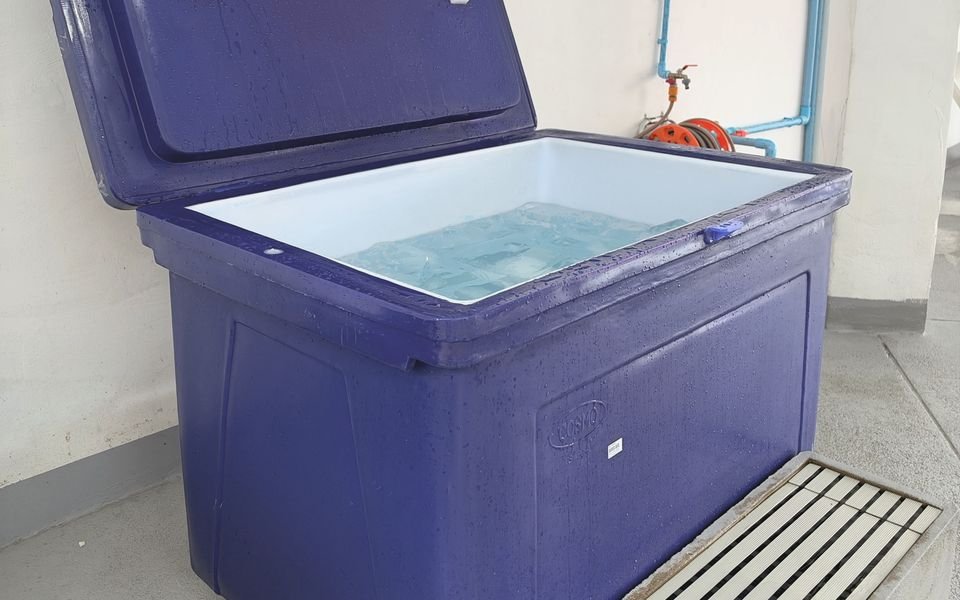
At Jomtien Sauna & Gym the ice bath is a lidded blue tub of water and ice with a slatted step beside it. Three signs set the house rules: shower before using the ice plunge, close the
A good first time looks like this. Warm up first with a round in the sauna or steam room, rinse off under the shower, then sit on the edge and lower yourself in slowly, feet first. Breathe out long and steady through the gasp. Aim for 30 seconds to a minute, then climb out, dry off and rest in the shade with some water. If you enjoyed it, try a second round after another spell of heat. The cold plunge pools next to the tub are there too if you want a change.
If you train in the gym on site, remember the note on strength training above and plan your cold for after cardio, a rest day or later in the day. For a full
Sources
- Met Office: Cold water shock, what it is and how to stay safe
- Bleakley et al. (2012), Cochrane Database of Systematic Reviews:
cold-water immersion for muscle soreness after exercise (PubMed) - Bieuzen et al. (2013), PLOS ONE: contrast water therapy and
exercise-induced muscle damage (PubMed) - Cain et al. (2025), PLOS ONE: effects of
cold-water immersion on health and wellbeing, a systematic review andmeta-analysis (PubMed) - Roberts et al. (2015), Journal of Physiology: cold water immersion after strength training (PubMed)
- NHS: Raynaud's
- Harvard Health Publishing: Saunas and your health

